
Listen to yourself
Replay your response. Notice missed words, repeated starts or pauses that interrupt the message.
A LITTLE PRACTICE. A CLEARER NEXT STEP.
Practise PTE speaking by recording a response, listening back and reviewing the feedback available for that task. Swiftuni supports Academic and Core speaking practice, with different question selections and scoring criteria. Choose one useful improvement before you record your next attempt.
Choose Academic or Core in your account. Access depends on your plan and available usage tokens.
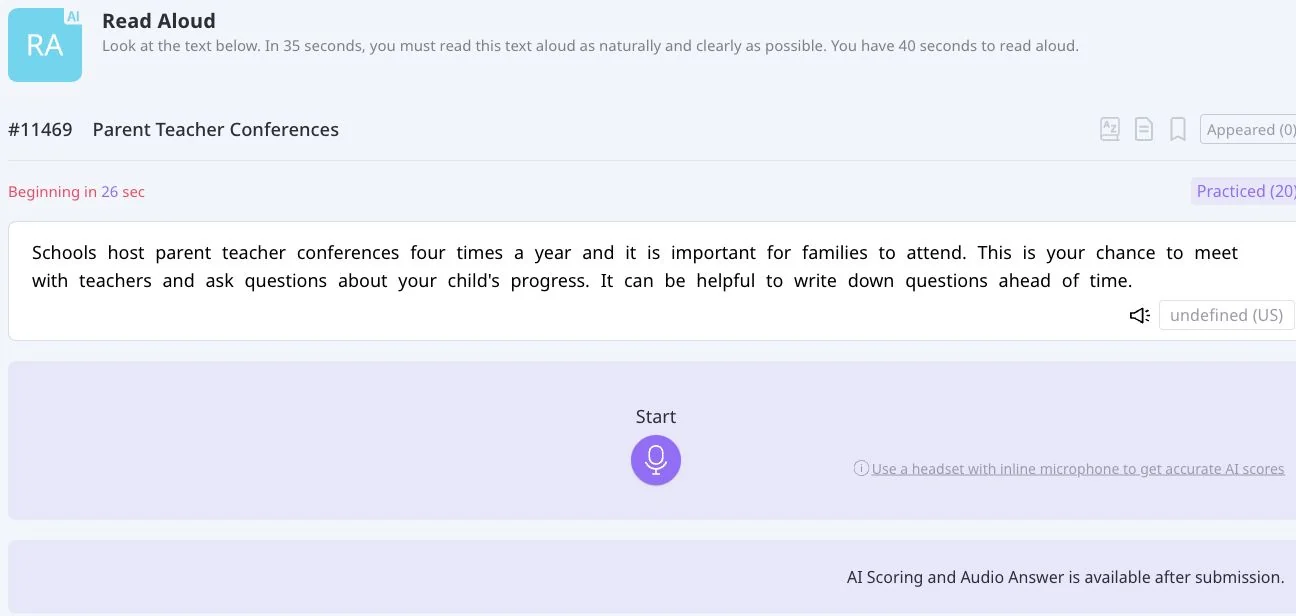
MAKE EVERY RECORDING USEFUL
Replay your response. Notice missed words, repeated starts or pauses that interrupt the message.
Look at the task-specific comments and transcript where provided. Check them against what you can hear.
Choose one change—such as completing the message or keeping a steadier pace—then try the task again.
KNOW YOUR TASK
Work on delivering the words accurately and keeping your response understandable.
Academic & CoreIdentify relevant information and communicate it as a clear, connected response.
Academic & CoreListen carefully and give the requested short answer. Don’t treat it as a long speaking response.
Academic & CoreConsider who you are speaking to, why you are speaking and what you need to communicate.
Academic & CoreListen for the key points and organise what you heard into your own spoken summary.
Academic onlyFollow the speakers’ main ideas and connections, then give a spoken summary.
Academic only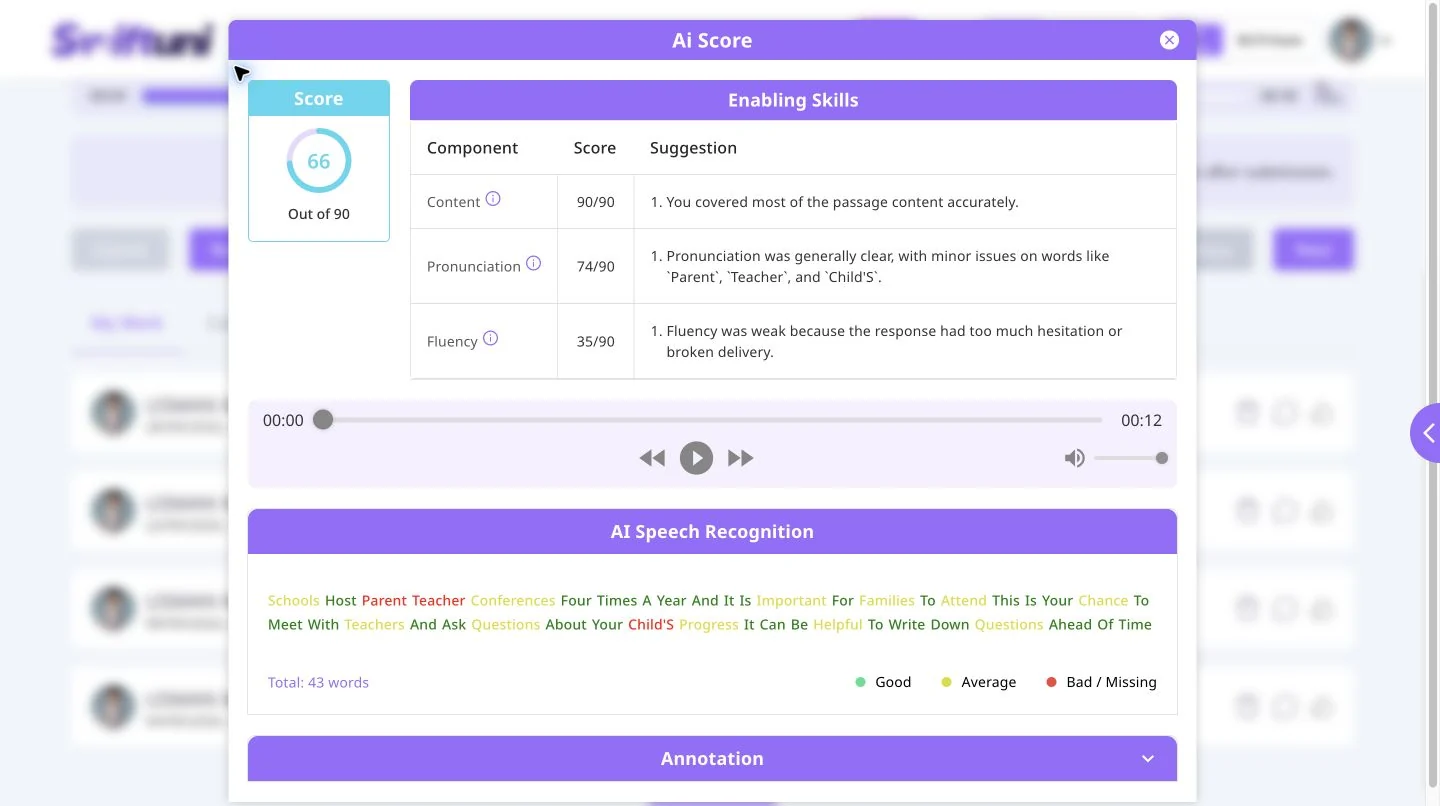
HEAR IT. CHECK IT. WORK ON IT.
The example pairs a recording with separate feedback for content, pronunciation and fluency. Read the suggestions, then check the highlighted words against the audio.
Here, the feedback identifies hesitation as an area to review. That gives the next practice session a clearer focus than the overall number alone.
Understand the feedback →BEFORE YOU PRESS RECORD
Use a quiet space, allow microphone access when your browser asks and check that your voice is audible. Keep the microphone position consistent when comparing attempts. Practice tools help you learn; they are not a substitute for the official test instructions.
How to read AI feedback →BEFORE YOU BEGIN
Task selection depends on Academic or Core. Shared tasks include Read Aloud, Repeat Sentence, Describe Image, Answer Short Question and Respond to a Situation. Re-tell Lecture and Summarize Group Discussion are Academic-only.
No. Criteria depend on the task. Content, pronunciation and fluency are relevant to supported extended responses, while short-answer and situational tasks have different requirements. Review the criteria shown for your response.
Speaking practice includes recording playback where available. Listen to the actual response alongside the feedback; do not rely on a score alone.
Check the recording first. Background noise, microphone placement and recognition errors can affect interpretation. Treat the transcript as a review aid, not an infallible record.
MAKE YOUR NEXT SESSION COUNT
Open Swiftuni in your browser, select your exam and choose a task that fits today.
Open the web app Check practice plans